Love tokens were a way for transported convicts to leave behind a memento for their loved ones back in England. They were simple coins which had been smoothed over and redesigned. Engravings sometimes included their name, a message and a drawing.
As I was searching through the love tokens, that of George Robotham’s stood out to me, as it was not addressed to anyone in particular (i.e. a loved one or partner) and there was a lack of detail on the token (i.e. pictures) which intrigued me and ultimately prompted me to research his back-story in an attempt to find more information. As he was only seventeen when he was transported, it is likely that his token was merely left to any family or friends rather than a significant other.
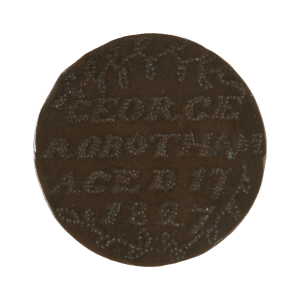
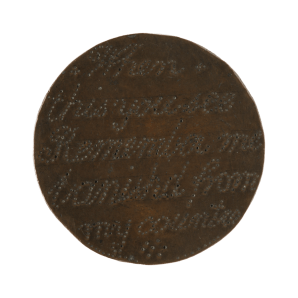
The use of the verb ‘banishd’ on the token conveys an emotion of betrayal and is perhaps representative of the anger and resentment he may have felt for his country for sending him to the other side of the world as a result of his crime. He was transported for the burglary of a cottage and following the Trial Warwick Assizes, he was transported for life, along with 158 other convicts, on 25th March 1827. After eight months of travelling, he arrived in Van Diemen’s Land (Tasmania) off the ship ‘Asia’ on 30th November 1827. [2]
After watching the film ‘Van Diemen’s Land’ (2009), I understood how difficult their lives were and many of them risked their own lives in an attempt to escape. You can watch the captivating trailer here. [3]
In my research, I discovered that his father, Robert Robotham, died on the 20th April 1823 (when George was just 14). He also lost 3 of his siblings, out of 4, in a short space of time. [4] Through this detailed exploration of his background, it is possible to find a potential explanation for his motive in crime. Losing his father at such a young age may have sent him down the road of criminality due to poverty. After all, his mother Kezia Crook was left as a single parent. Robotham’s crime could have been a result of desperation and despair, perhaps highlighting his struggle. Robotham was a Labourer by trade was last working in Plaiting and Silversmiths work. [5] He probably felt a responsibility and growing pressure to provide for his family.
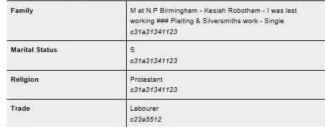
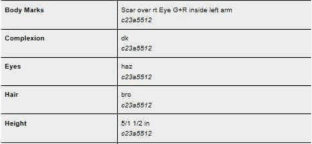
In a description of George Robotham, a scar above his eye is mentioned (below). This visualisation of his physical appearance leaves a sense of ambiguity as to what the scar could represent; was he a rebellious child and therefore destined to a life of crime? I found it interesting that his mother’s maiden name was Crook, which is ironic considering he indeed becomes a criminal! However, it seems unlikely to me that he was destined to crime, especially after discovering that he went on to live a crime-free life. On 19th September 1837 he married Ann Susanah Harris, who was also a convict (she was transported three years before him, also aged seventeen). They married in Launceston, Tasmania and they had nine children together, born between 1837 and 1853. [7] REFERENCE…
Bibliography
- [1] ‘When this you see Remember me banishd from my country’, George Robotham, 1827, accessed on 15th October 2018 http://lovetokens.nma.gov.au/search/2008.0039.0068?q=george+robotham+
- [2] George Robotham, accessed 19th October 2018. http://www.chestnut-blue.com/Chestnut%20Blue-o/p887.htm#i49053
- [3] Van Diemen’s Land Official Trailer, 16th August 2009. Accessed 19th October 2018. https://www.youtube.com/watch?v=FflJG71FpCw
- [4] George Robotham, accessed 20th October 2018. https://www.ancestry.co.uk/search/?name=George_Robotham&event=_warwick-warwickshire-england-united+kingdom_88159&birth=1810&gender=m, DATE, accessed on 17th October 2018
- [5] George Robotham, accessed 19th October 2018. https://www.ancestry.co.uk/search/collections/mediaphotopublic/?name=George_Robotham&gender=m&keyword=convict&pcat=43&qh=KUtXT4bHpyBCOHOMKd2QFQ%3D%3D
 Prison Voices
Leave a comment