Criminal broadsides, often labelled ‘The Last Dying Speeches’ [1] were a one-sided sheet of paper containing the confessions and trials of condemned criminals. They were viewed as the ‘popular literature of ordinary people’ [2] and the forerunner of the popular press. This subcategory of the street literature industry was mocking and condemning, but most importantly, entertaining!
Whilst I was searching through the reams of Criminal Broadsides listed online, I was not surprised to find that most of them depicted male crime, as this uneven ratio is reflected by the fact that of the 59 people hanged in London 1827-30, only 4 were women). That being said, I was instantly drawn to the rare case of a woman. I have focused on the case of Elizabeth Wratten – a woman who was transported for life for the alleged forgery of a check worth £60.
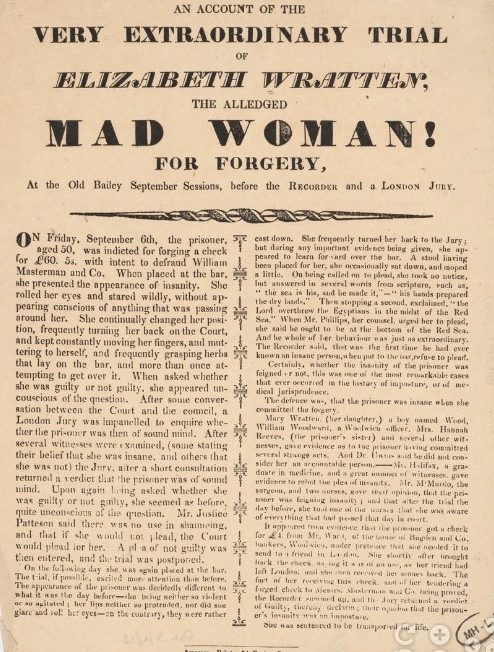
This, rather fascinating, example evokes a deep feeling of sympathy in me towards the criminal, despite its obvious intention of creating a sense of humour. Unlike most other broadsides, there is a lack of dialogue from Elizabeth Wratten herself as she is described as ‘insane’ in court, highlighting her strange behaviours such as “muttering to herself” and “more than once attempting to get over [the bar]”.
Despite the fact that she is clearly a troubled woman, the writer sets out to dehumanise her and this is emphasised with the bold and humiliating title which labels her the ‘MAD WOMAN!’. I felt that it was disagreeable to draw on one’s failing mental health in an attempt to create ‘laughs’ amongst readers. It’s almost as if there were no moral boundaries in the 19th century; as long as a story would sell in their millions and make money, then the rights of the individual were marginalised.

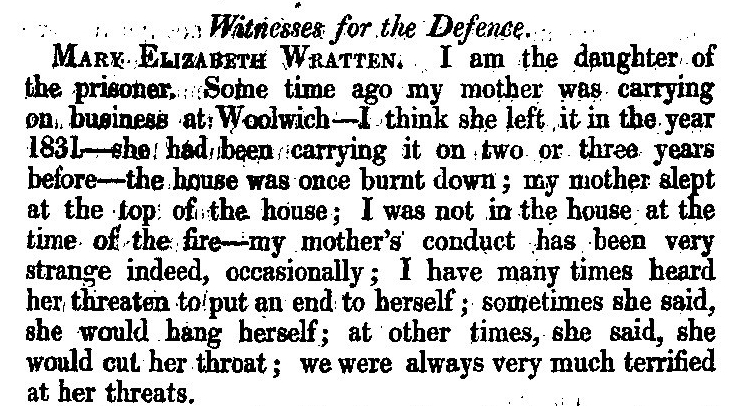
The writer draws on Elizabeth Wratten’s seemingly ridiculous responses to questions asked in court. For example, upon being asked whether she was guilty or not, she responded in an unrelated fashion, stating, “the sea is his, and he made it”. After seeming “unconscious of the question”, the court decided to take the decision into their own hands which I felt was unfair and cruel. Below, there is a statement from Wratten’s daughter, stating that her mother had previously displayed strange behaviours. However, this is not taken into consideration. There are no efforts or attempts made to acknowledge and allow for her illness, perhaps be more understanding in court, but they merely label her as guilty and punish her accordingly.
Bibliography
[1] ‘Harvard Law School Library’s Crime Broadsides’, Harvard Library. Accessed on 30th November 2018. https://library.harvard.edu/collections/harvard-law-school-librarys-crime-broadsides
[2] Leslie Shepard, “The History of Street Literature: The Story of Broadside Ballads, Chapbooks, Proclamations, News-Sheets, Election Bills, Tracts, Pamphlets, Cocks, Catchpennies, and Other Ephemera”, 26 April 1973, page 14.
[3] ‘Witness for the Defence’, Proceedings of the Old Bailey, 5th September 1833, page 63. Accessed on 4th December 2018. https://www.oldbaileyonline.org/images.jsp?doc=183309050063
‘An Account Of The Very Extraordinary Trial Of Elizabeth Wratten, The Alleged Mad Woman! For Forgery At the Old Bailey September sessions, before the Recorder and a London Jury’, 1833, Harvard Library Online. Accessed on 2nd December 2018. http://curiosity.lib.harvard.edu/dying-speeches-and-bloody-murders-crime-broadsides/catalog/9-008086119
 Prison Voices
Leave a comment